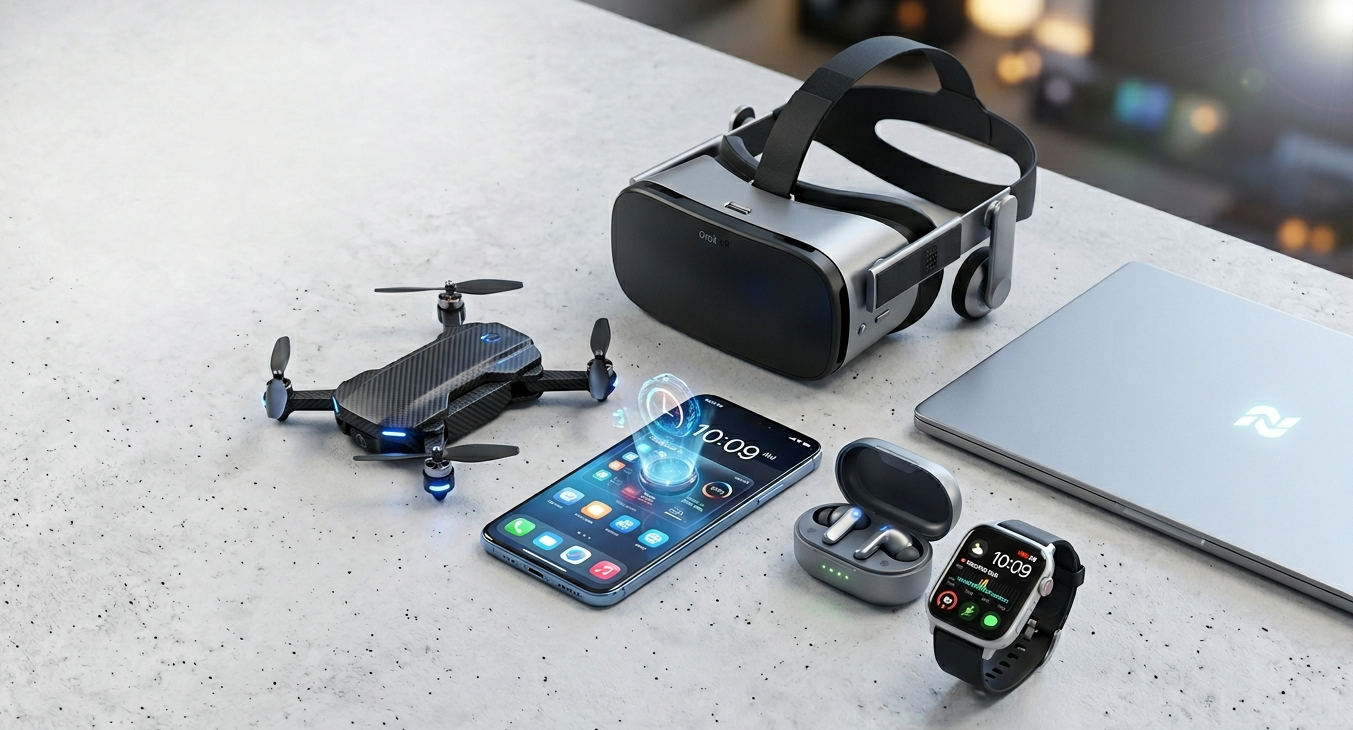
The Indian gadget market in mid-2026 is simultaneously the best it has ever been for buyers — more choice, more capability per rupee than any previous year — and the most confusing. Every brand launches a “Pro” model every six months. Spec sheets are designed to impress rather than inform. Online reviews are frequently written by people who used a device for two days at a press event rather than two weeks of actual use.
This guide cuts through that confusion with a simple structure: for each category, it tells you what to buy at each realistic Indian budget point, what to avoid, and critically, when to skip the upgrade entirely — because not every category justifies spending money in 2026.
Every recommendation here is based on devices available in India right now, priced at current Indian retail rates. Where a device has a significant flaw that affects daily use, that flaw is stated. The goal is to help you spend confidently, not to generate affiliate clicks.
Smartphones: The Right Phone at Every Budget
Under ₹10,000 — Buy: Redmi A4 5G
The sub-₹10,000 smartphone segment has undergone a genuine transformation in 2026. You no longer have to give up 5G connectivity at this price. The Redmi A4 5G, starting at approximately ₹7,499, delivers a Snapdragon 4 Gen 2 processor, a 5,000mAh battery that consistently delivers two days of moderate use, and a 6.88-inch HD+ display. For a student, a secondary device, or a parent’s first smartphone, this is a genuinely capable device.
Honest limitation: The camera system is basic by any standard above this price. In good light it produces usable photos; in low light and indoors it struggles. If photography matters at all, allocate more budget.
What to avoid: No-brand Android phones below ₹5,000 on Amazon and Flipkart from manufacturers with no service centres. When they fail — and at this build quality, they will — you have no recourse.
₹10,000–₹20,000 — Buy: Nothing Phone 3a
The Nothing Phone 3a at ₹24,999 (recently reduced to ₹21,999 for the base variant during Flipkart sales) is the most compelling mid-range Android available in India in 2026. The Snapdragon 7s Gen 3 processor is fast in daily use, the Nothing OS 3.0 on Android 15 is clean and bloat-free, and the company has committed to three years of OS updates and four years of security patches — the strongest software commitment in this price bracket.
The Glyph Interface is a legitimate differentiator for notification management once you configure it, though it requires setup patience to be useful rather than distracting.
Honest limitation: Nothing’s service centre network is still primarily metro-concentrated. If you are in a tier-2 or tier-3 city and face a hardware issue, warranty service requires courier shipping. Factor this into your decision.
Strong alternative: The Redmi Note 14 Pro at ₹19,999 offers a better camera system (especially in low light, where its 50MP Sony LYTIA sensor outperforms the Nothing Phone 3a) and a more established service network. If photography is your primary use case, the Redmi wins at this price. If clean software and long-term updates matter more, Nothing wins.
₹25,000–₹40,000 — Buy: iQOO Neo 10
The iQOO Neo 10, priced from ₹29,999, has redefined the ₹30,000 price bracket in 2026. The Snapdragon 8s Gen 4 processor is a genuine flagship chip at a mid-range price — its gaming and multitasking performance matches phones costing twice as much. The 6,000mAh battery with 80W fast charging means you can take a 15-minute charge from near-empty to approximately 50% before leaving home.
iQOO’s V3 cooling system specifically addresses the thermal throttling problem that plagued previous performance-focused mid-range phones — sustained gaming sessions no longer result in the same dramatic performance drops that were common in this segment a year ago.
Honest limitation: Funtouch OS (iQOO’s Android skin) remains bloated compared to Nothing OS or stock Android. Pre-installed apps require manual removal. The camera system, while competent, does not match the computational photography of Samsung or Google at similar or higher prices.
Skip this bracket if: You primarily use your phone for basic tasks — calls, messaging, social media, video streaming. A ₹15,000–20,000 phone handles these identically, and the extra ₹10,000–15,000 buys performance that only becomes visible in gaming or intensive multitasking.
Above ₹80,000 — Buy: Samsung Galaxy S25
The Samsung Galaxy S25 (starting ₹80,999) remains the benchmark Android flagship in India in 2026 for one reason that matters more than any spec: seven years of guaranteed OS and security updates. In a world where a ₹80,000 phone should realistically last five to seven years with good care, Samsung’s software commitment is the only one in Android that matches that lifespan.
The Snapdragon 8 Elite processor is the fastest mobile chip available. The camera system — particularly video stabilisation and low-light photography — is genuinely class-leading among Android devices sold in India.
Honest verdict on Apple vs Samsung in this bracket: The iPhone 16 (starting ₹79,900) is the alternative. For users already invested in the Apple ecosystem — AirPods, Mac, iPad, iCloud — the iPhone 16 is the better choice because ecosystem integration multiplies the value of every device. For Android ecosystem users, the Galaxy S25’s hardware is marginally superior at the base price point. The ecosystem decision matters more than any spec comparison.
Laptops: The One Decision That Changes Everything
The most important laptop buying decision in 2026 is architecture: x86 (Intel/AMD) versus ARM (Qualcomm Snapdragon X / Apple M-series). This is not a technical detail — it is a purchase decision that affects battery life, performance, and application compatibility for the full life of the laptop.
Under ₹50,000 — Buy: Lenovo IdeaPad Slim 5x (Snapdragon X Plus)
The IdeaPad Slim 5x with Snapdragon X Plus, available at approximately ₹55,000–58,000 on current sale pricing, delivers battery life that is categorically different from anything in this price range on x86 architecture. Consistent 13–15 hours of mixed productivity use is not marketing language — it is independently verified by multiple reviewers. For a student or professional who works away from outlets regularly, this difference is transformative.
Critical check before buying: Verify that the applications you use daily run natively on Windows ARM. Microsoft Office, all major browsers, most productivity tools, and web-based applications run natively. Certain older professional software and games may require emulation, which works but with a performance penalty. Run this check before purchase; most Qualcomm Snapdragon X retailers provide compatibility information.
The x86 alternative: AMD Ryzen 7 8845HS-based laptops (HP Omen, ASUS Zenbook 14) in the ₹65,000–75,000 range offer maximum application compatibility and strong performance, with battery life of 7–9 hours. If application compatibility is a concern or you run GPU-intensive work, this remains the practical choice.
Best Overall Laptop (Any Budget) — Apple MacBook Air M4
The MacBook Air M4 (starting ₹99,900) is the laptop recommended by a larger fraction of professional tech reviewers than any other single device in 2026 — not out of brand loyalty but because the combination of M4 performance, 15–17 hour battery life, completely silent operation (no fan), display quality, and Apple’s multi-year software support is genuinely unmatched at this price.
For Indian buyers specifically: Apple’s service network has expanded to over 4,000 authorised service providers, including in tier-2 cities. The Apple Store in Mumbai and Delhi provide same-day diagnosis for hardware issues.
Honest limitation: The base model’s 16GB unified memory is sufficient for most tasks but not for video editing with 4K+ footage or complex software development environments. If either is your primary use, either configure with 24GB (approximately ₹1,19,900) or consider a Windows alternative.
The platform question: If your work requires Windows-specific software — legacy enterprise applications, Windows-only professional tools — the MacBook is wrong regardless of how good the hardware is. Software compatibility is not optional.
Truly Wireless Earbuds: Where to Spend and Where Not To
Under ₹2,000 — Buy: boAt Airdopes 141 (Gen 2)
At approximately ₹1,299, the Airdopes 141 Gen 2 remains the benchmark for genuinely usable TWS earbuds at this price. 42-hour total playtime, adequate call quality for voice and video calls, and a fit secure enough for commuting distinguish it from the generic earbuds sold below this price that offer only slightly inferior specs for meaningfully inferior build quality and reliability.
What you do not get at this price: Active Noise Cancellation that actually works. ANC at below ₹2,000 is a marketing checkbox, not a functional feature.
₹3,000–₹6,000 — Buy: Sony WF-C710N
The Sony WF-C710N at approximately ₹5,990 represents the price point where audio quality, ANC performance, and build quality all reach a standard that genuinely improves the daily listening experience rather than just adding features on paper.
Sony’s audio tuning expertise is audible at this price point in a way it is not in budget segments. The balance between bass, midrange, and treble is more natural than the bass-heavy tuning of most Indian-brand competitors at similar prices. ANC handles consistent low-frequency noise (transport, AC, open offices) effectively at this price.
When to skip this bracket: If you primarily use earbuds for calls and occasional audio in quiet environments, the extra ₹3,000–4,000 over the boAt Airdopes buys audio quality you may not notice in typical use. Save the difference toward a purpose that matters more to you.
Above ₹20,000 — Buy: AirPods Pro 2 (iPhone users only)
The AirPods Pro 2 at ₹24,900 are the best TWS earbuds available in India if you use an iPhone. Full stop. The H2 chip’s Adaptive Audio — seamlessly blending ANC and transparency based on your environment — works better in real-world conditions than any competing implementation. The hearing health features added through firmware, including a basic audiogram function, add genuine utility beyond audio quality.
The platform lock caveat: AirPods Pro 2 lose approximately 60–70% of their intelligent functionality on Android devices. The ANC still works. The sound quality is still good. But the automatic ear detection, seamless device switching within the Apple ecosystem, Adaptive Audio, and health features either do not function or function at reduced capability. For Android users, Sony WH-1000XM6 (approximately ₹29,990) or Samsung Galaxy Buds 3 Pro (approximately ₹17,990) are the correct premium choices.
Smartwatches: The Market Is More Segmented Than It Appears
Under ₹5,000 — Buy: Noise ColorFit Ultra 3
The Noise ColorFit Ultra 3 at ₹3,499 is the current benchmark for Indian-brand smartwatches at this price. The AMOLED display is genuinely good — sharp, bright, readable outdoors — and the health sensors (heart rate, SpO2, stress) perform with acceptable accuracy for non-clinical use. GPS accuracy for outdoor runs is adequate for tracking distance and pace.
Honest limitation: Software support and app ecosystem for Indian-brand smartwatches remain limited compared to Samsung and Garmin. The companion app works but lacks the depth of Google’s Wear OS or Samsung’s One UI Watch. If app ecosystem matters to you, this limitation is real.
₹15,000–₹35,000 — Buy: Samsung Galaxy Watch 7
The Galaxy Watch 7 (₹29,999) is the most capable smartwatch for Android users at its price in India. The BioActive sensor for ECG, blood pressure trend monitoring, and body composition functions work in India — unlike some health features on competing devices that are geofenced out of the Indian market. Google Maps, Google Pay, and YouTube Music all function natively off-phone.
Battery reality: The always-on display mode runs the Galaxy Watch 7 down in approximately 40–44 hours, meaning daily or every-other-day charging is required. If you want a watch that lasts a week, look at Garmin’s range starting at ₹15,000 — you trade smartwatch features for endurance, which is the right trade for outdoor and fitness-first users.
The Honest Upgrade Advice: When Not to Buy
The gadget review industry has a structural bias toward recommending new purchases. No review site earns affiliate revenue by telling you not to upgrade. This guide does.
Don’t upgrade your phone if it runs Android 12 or later, the battery still charges to above 80% capacity, and it handles your daily apps without stuttering. A two-year-old flagship in good condition outperforms a new budget phone in nearly every real-world use case. The urge to upgrade is often marketing-driven rather than need-driven.
Don’t buy TWS earbuds above ₹10,000 if you primarily use them for calls on public transport. Call quality in noisy environments is more about microphone quality and wind noise suppression than audio driver quality — and these characteristics plateau at approximately ₹5,000–8,000. The extra spend buys audio performance that commute noise will mask anyway.
Don’t buy a new laptop if your current one handles your actual workload and the primary motivation is the new design or a faster processor you will not use. The Snapdragon X and Apple M4 advances are real. They are most meaningful for users who are battery-constrained or who run compute-intensive workloads. For typical browsing, document editing, and video calling, a 2021 laptop running updated software is functionally equivalent to a 2026 laptop for those tasks.
Don’t buy a smartwatch for health tracking if you will not charge it consistently. A smartwatch that sits on the charger half the time provides no health data from that time. If charging discipline is realistically a challenge, a simple fitness band (Mi Band 9, approximately ₹2,499) with a 14-day battery is more useful than a feature-rich watch you will not wear consistently.
The Gadgets That Represent Genuinely Underappreciated Value in 2026
Beyond the category leaders, three specific product types are consistently undervalued in Indian gadget buying decisions:
A good mechanical keyboard if you type more than four hours a day. A Keychron K2 or K6 (₹7,000–12,000) reduces typing fatigue measurably over membrane keyboards. For writers, coders, and anyone in data-heavy roles, this is a productivity investment with returns that far exceed the cost. This is the category most likely to be overlooked in gadget recommendation lists because it is not glamorous.
A monitor arm if you work from a desk. A decent single-monitor arm (₹2,000–4,000 from brands including Ergotron or local equivalents) allows ergonomic positioning that a fixed monitor stand cannot. The reduction in neck and shoulder strain from correct monitor height and distance has real quality-of-life value for full-time desk workers.
A power bank above 20,000mAh with 65W+ output if you travel regularly. Portable laptop charging has become viable and practical in 2026 with high-output power banks. Baseus and Ugreen both offer 20,000mAh power banks with 65W output capable of charging a modern laptop at approximately ₹2,500–4,000. For anyone who travels or works away from outlets, this is more practically valuable than a new pair of earbuds at the same price.
Final Guidance: The Five Questions Before Every Gadget Purchase
Before completing any gadget purchase above ₹5,000, run through these five questions:
Does this solve a real problem I currently have, or does it solve a problem I do not currently experience? If the honest answer is the second, reconsider.
Is there a model one generation older at a significantly lower price that covers 90% of my actual use cases? For many categories, the answer is yes.
Have I checked the service centre situation in my city for this brand? One warranty claim with no local service centre is more frustrating than the feature gap between brands.
Does the software support timeline match how long I expect to own this? A phone with one year of updates remaining is a worse purchase than a phone with four years remaining, regardless of other specs.
What does a one-star verified review on Flipkart say? One-star patterns reveal real-world failure modes that three-day review windows miss entirely.
If all five answers support the purchase, buy confidently. If any reveals a significant concern, take another day before deciding.
Prices mentioned are indicative of Indian retail as of May 2026 and are subject to change across retailers and during sale events. The author has no affiliate relationship with any brand or retailer mentioned. This article is for informational purposes only. Readers are encouraged to verify current pricing, availability, and service centre locations before purchasing.
Mahesh is a consumer technology reviewer covering smartphones, laptops, audio hardware, and buying guidance for Indian consumers.
