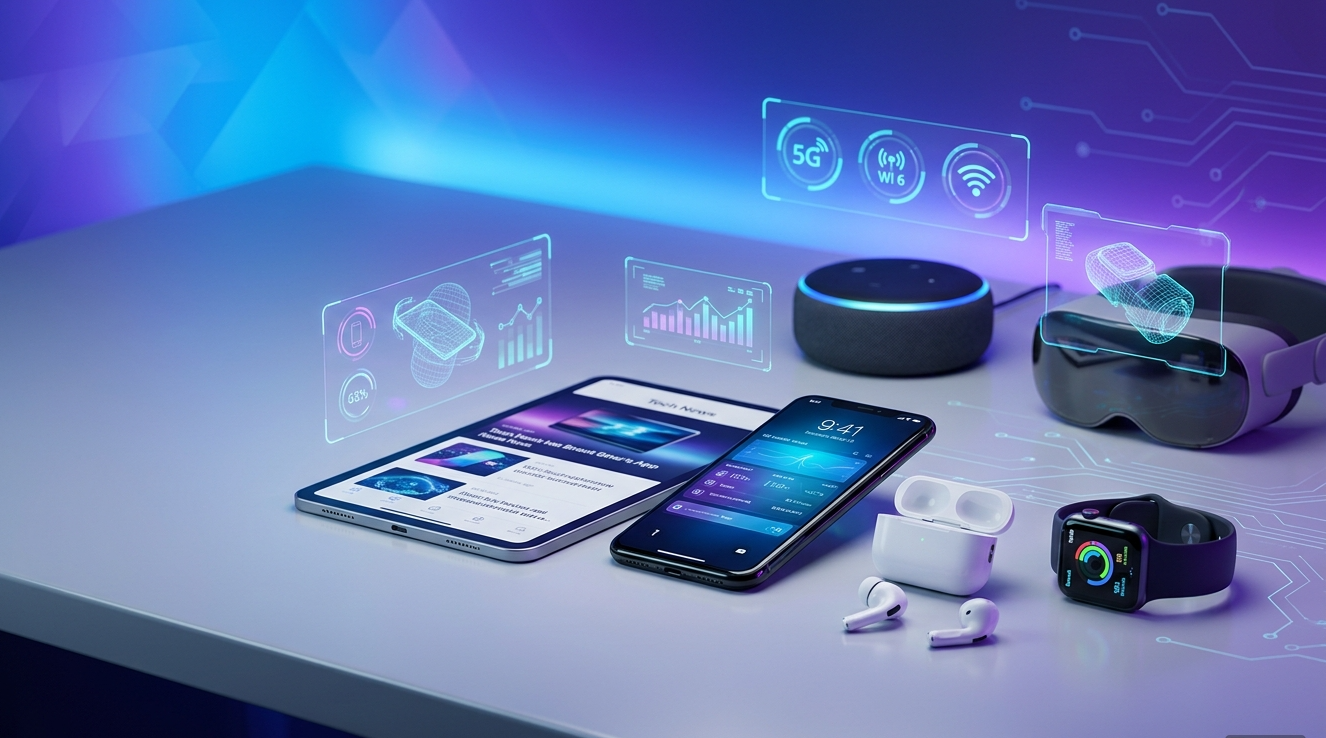
Every gadget launched in 2026 has AI in it. AI cameras. AI noise cancellation. AI health insights. AI translation. AI on-device processing. The word has been applied so broadly and to so many products that it has become almost meaningless — a marketing flag rather than a functional descriptor.
The genuinely important question is not whether a gadget has AI, but whether that specific AI feature changes how you use the device in daily life. And the honest answer varies dramatically by product and by feature. Some AI implementations in 2026 gadgets are genuinely transformative — they do things that were impossible twelve months ago and that make a real difference in daily use. Others are benchmark-padding features that exist to appear on a spec sheet and are never used after the first week.
This review guide tests five categories of AI-featured gadgets against one specific standard: does the AI feature solve a problem you actually have, and does it solve it better than what you had before? Where the answer is yes, the product is worth considering. Where the answer is no — regardless of how impressive the feature sounds in a press release — it is called out clearly.
Smart Glasses: The AI Feature That Finally Justifies the Category
Smart glasses have been the “almost ready” gadget category for nearly a decade. Google Glass failed. Early AR glasses were expensive, conspicuous, and fragile. The category has been announced as ready multiple times without actually being ready.
In 2026, something genuinely changed. The Ray-Ban Meta smart glasses — now in their third iteration with real-time AI translation and a significantly improved open-ear speaker — represent the first smart glasses that most people will actually wear consistently. The specific combination that makes them work: they look like regular glasses (removing the social awkwardness of previous designs), the open-ear audio is good enough for music and calls without headphone isolation, the AI assistant responds to natural voice commands without requiring a phone unlock, and the real-time translation feature works reliably across 20+ languages.
The AI translation is the specific feature that crosses the “genuinely useful” threshold. At CES 2026 and MWC 2026, multiple reviewers independently noted that the face-to-face translation mode — where the glasses translate what the person in front of you is saying and play it through the earpiece in your language — functions well enough for real conversations, not just demo conditions. For Indian users who travel internationally, manage international business calls, or communicate across India’s own linguistic diversity, this feature is substantively useful in a way that “AI camera” or “AI noise cancellation” simply is not.
India availability and pricing: Ray-Ban Meta glasses are available in India through authorised eyewear partners at approximately ₹19,000–25,000 depending on frame style. Prescription lens compatibility is available at additional cost.
The honest limitation: Battery life is approximately 4–6 hours of active use, which is adequate for a workday but requires charging during longer use. The camera resolution (12MP) is good for casual photo capture but not for content creation. And the AI features require an active internet connection — they do not function offline, which limits utility in areas with unreliable mobile data.
Verdict: Buy if you travel internationally, manage multilingual communication, or do outdoor activities where phone-free audio is genuinely valuable. Skip if you primarily want music playback — at this price, dedicated earbuds from Sony or Apple deliver meaningfully better audio quality.
AI Health Wearables: Sorting What’s Clinically Meaningful From What’s Not
The health wearable market in 2026 has bifurcated sharply: devices with clinically meaningful sensors that generate actionable data, and devices with marketing-label sensors that generate impressive-looking numbers that mean very little.
The Samsung Galaxy Watch 7 — Where AI Health Features Actually Work
The Samsung Galaxy Watch 7’s BioActive sensor represents the state of the art in smartwatch health monitoring available in India. Three specific AI-powered features deserve individual assessment:
ECG and Atrial Fibrillation detection: Clinically validated, available in India (unlike some health features that remain geofenced), and genuinely useful. The watch’s AI continuously monitors for AFib patterns during wear and alerts you if irregular rhythm is detected. Multiple documented cases — in India and globally — have involved patients discovering undiagnosed AFib through their smartwatch before experiencing symptoms. This is not wellness data. It is clinically relevant data that can prompt life-changing medical consultation.
Blood Pressure Trend Monitoring: Samsung’s approach is important to understand precisely. The Galaxy Watch 7 does not measure absolute blood pressure — it measures trends in blood pressure relative to a calibration baseline you establish using a standard cuff. The AI monitors whether your relative blood pressure is trending higher or lower over time. This is genuinely useful for tracking whether lifestyle changes or medication are working. It is not a replacement for clinical blood pressure measurement.
Body Composition Analysis: The bioelectrical impedance analysis (BIA) feature estimates body fat percentage, skeletal muscle mass, and other body composition metrics. The accuracy varies significantly with hydration level, and the absolute numbers are less reliable than a clinical DEXA scan. The value is in tracking relative changes over time rather than in the absolute measurements themselves — which the Samsung health app communicates clearly.
The Subscription Trap in Health Wearables
One AI health feature evaluation criterion from a thorough 2026 gadget review framework is worth applying directly to the Indian market: does the AI feature require a subscription, and is that subscription priced in INR or USD?
Several health wearable AI features that appear to be included with device purchase are actually subscription-dependent after a trial period. Oura Ring’s advanced AI insights require a monthly subscription (approximately ₹1,000–1,200/month at current exchange rates). Whoop’s entire value proposition is subscription-locked. Some Fitbit AI features require Fitbit Premium.
For Indian consumers on a monthly subscription, the total cost of ownership calculation changes substantially. A wearable that costs ₹15,000 with a ₹1,000/month AI subscription costs ₹27,000 over one year. Understanding whether the features you actually want are included or subscription-gated before purchase is essential, not optional.
Samsung Galaxy Watch 7 and Galaxy Buds Pro AI features are included without additional subscription — a specific advantage over several competitors.
Foldable Phones: The CES 2026 Hype vs the Reality Available in India
CES 2026 generated significant excitement around foldable technology. Samsung showcased a creaseless foldable display — a technology demonstrator where the familiar fold line visible in current foldable phones was completely absent. The display flexed smoothly with no perceptible crease line, and Samsung claimed durability through hundreds of thousands of folds. This was genuinely impressive.
Here is the India-relevant reality: the creaseless display is not yet available in a product you can buy. It is a technology demonstration of what is coming. The Samsung Galaxy Z Fold 6 and Z Flip 6, which are actually available in India, still have visible crease lines — less pronounced than previous generations but present. The creaseless technology is expected to appear in the Galaxy Z Fold 7, anticipated in H2 2026.
The foldables actually available in India in mid-2026 and worth considering:
Samsung Galaxy Z Fold 6 (₹1,64,999): The most mature book-style foldable available. The hinge is among the most durable in the market (Samsung’s IPX8 rating and the solid hinge mechanism survive typical use scenarios reliably). The 7.6-inch inner display is genuinely useful for multitasking, reading long-form content, and split-screen productivity. The AI features — Live Translate in phone calls, Note Assist for meeting summaries, and Circle to Search — are among the more useful AI features in any Android device available in India in 2026.
Who actually benefits from a foldable: People who consistently carry both a phone and a tablet for different tasks and would genuinely use the larger screen daily. People who travel frequently. People who read long documents, review contracts, or edit spreadsheets on mobile regularly. People who want tablet-size content consumption with phone portability.
Who should wait: Anyone primarily influenced by the “cool factor.” Anyone whose primary phone tasks are messaging, social media, and photography — a standard flagship handles all of these better per rupee. Anyone in a profession that requires a screen-protector-free camera system (current foldables have inner screen protectors that reduce camera clarity for selfies).
The AI test for foldables: Samsung’s Galaxy AI features on the Z Fold 6 are the most genuinely integrated AI feature set available on any foldable in India. Live Translate working on phone calls in Hindi and English, Photo Assist for real-time object removal in photos, and the taskbar + split-screen combination represent a genuinely different productivity workflow from a standard smartphone. These AI features justify the “smart” label more than most. The price premium, however, means the audience remains specific rather than mainstream.
AI Earbuds: What “Adaptive Audio” and “AI Noise Cancellation” Actually Mean
The TWS earbud market has attached “AI” to almost every feature in the past 18 months. Breaking down what is genuinely AI-powered versus what is traditional signal processing marketed as AI:
Genuinely AI-powered features in 2026 earbuds:
Apple AirPods Pro 2’s Adaptive Audio is the clearest example of AI-driven audio adaptation that functions meaningfully differently from manually selected ANC modes. The H2 chip’s machine learning model continuously analyses your acoustic environment — the frequency profile of ambient noise, whether you are talking or listening, your movement patterns — and blends transparency and noise cancellation dynamically without requiring you to select a mode. The practical experience is that you never think about which mode to use. The system handles it. This is AI doing something you could not easily replicate manually.
Sony’s Speak-to-Chat on the WF-1000XM6 and WH-1000XM6 uses AI to detect when you start speaking and automatically pauses music and switches to transparency mode, then returns to ANC when you stop. This is a narrow but genuinely useful AI application — it replaces a button press you would otherwise have to make multiple times per day.
EarFun’s AI Clip 2, highlighted at CES 2026, introduced real-time AI translation in an earbud — supporting 100+ languages through the companion app with face-to-face and real-time conversation modes. For Indian users frequently navigating multilingual conversations, this feature in a sub-$60 device is worth noting, though India availability and pricing need verification at time of purchase.
Features marketed as AI that are traditional signal processing:
“AI noise cancellation” on budget earbuds under ₹3,000 is almost universally traditional feedforward/feedback ANC with an AI label applied. The ANC hardware and algorithm quality in this price range is what limits performance — not the presence or absence of machine learning. The label is marketing, not function.
“AI bass boost” and “AI sound enhancement” in most budget Indian-brand earbuds similarly describe equalizer presets with an AI label. The sound does not adapt dynamically — a preset is applied and called AI.
The practical test for any AI audio claim: Does the feature respond differently in different situations without you changing any setting? If it requires you to manually select a mode, it is not AI adaptation. If it genuinely changes behaviour based on context without manual input, it may legitimately be AI-powered.
AI in Smartphones: The Features Worth Using and the Ones to Ignore
Every major Android flagship and iPhone in 2026 includes what manufacturers label “AI features.” Cutting through to what is worth actually using:
Circle to Search (Android — Samsung/Google Pixel): Genuinely useful. Hold the home button, circle anything on your screen, and Google searches for it. Identifying a plant in a photo, searching for a product you see in a video, looking up a song playing in a YouTube video — all handled without leaving the app you are in. This is the AI feature that most consistently earns its presence in daily use.
Live Translate on Samsung Galaxy (phone calls and chat): The real-time call translation that works between languages including Hindi, Tamil, English, and Korean is a genuinely useful feature for the specific use case of cross-language calls. For international business users or NRIs managing family calls across language barriers, this changes a previously frustrating experience meaningfully.
Google’s Call Screen and Direct My Call (Pixel): Screens unknown calls and reads out automated menu options before you interact with a call, letting you decide whether to answer. Reduces both spam calls and the time spent navigating phone trees. Available on Pixel devices in India.
AI Photo Editing (Remove Objects, Unblur, Magic Eraser): These features work well for casual social media use. For professional photography, dedicated editing software is still meaningfully superior. The target user is someone who wants a quick fix for a casual shot — for whom these features are genuinely convenient.
AI features to actively ignore:
“AI Wallpaper Generation” — creates generative AI wallpapers. Interesting for ten minutes, unused thereafter.
“AI Drawing Assist” — generates art based on rough sketches. Used by a small fraction of device owners.
“AI Writing Assistant” in email or notes apps — for most Indian users, typing out their own messages is faster and more accurate than prompting an AI to generate them. Potentially useful for drafting in a second language; less useful in your primary language.
Smart Home AI: The Matter Standard and What It Means for Indian Buyers
At CES 2026, smart home interoperability through the Matter standard was a consistent theme. Govee’s new lights integrated with Samsung SmartThings; Aqara and Philips Hue expanded Matter compatibility; the message from manufacturers was that devices from different brands should now work together through a single app.
For Indian buyers, this is welcome news with an important caveat: Matter compatibility requires a Matter hub or a compatible smart speaker. Amazon Echo (4th gen), Google Nest Hub, and Apple HomePod all function as Matter hubs. Without one, Matter-compatible devices still require brand-specific apps.
The AI features in smart home devices that are worth the investment:
AI energy monitoring — smart plugs that learn your appliance usage patterns and identify devices left on unnecessarily, provide monthly energy reports, and flag unusual consumption spikes. The Syska Smart Plug (₹999) and Havells IoT Smart Plug (₹1,299) both support energy monitoring with companion app integration.
AI-powered robot vacuums with obstacle recognition — the Roborock S8 MaxV (approximately ₹79,000), which uses a camera and AI to recognise and avoid specific objects (cables, shoes, pet waste) rather than just bumping into them, represents the current practical state of the art in India. The AI obstacle recognition is the specific feature that makes this generation meaningfully better than previous ones that required you to tidy before running the vacuum.
What to wait on: Humanoid home robots (LG’s CLOiD, SwitchBot’s Onero H1 laundry-folding robot) shown at CES 2026 are genuinely impressive demonstrations. They are not yet available for purchase at consumer price points, and their real-world performance in actual home environments — unstructured spaces rather than controlled demo conditions — has not been independently evaluated at scale. Do not let CES excitement generate a purchase impulse for products that are not yet available or not yet proven outside demo conditions.
The Honest AI Feature Evaluation Framework
Before any AI-featured gadget purchase above ₹10,000, apply these three questions from the most useful AI gadget evaluation criteria identified in 2026 reviews:
Does it have local processing, or does it need the cloud for everything? Local processing (AI running on the device’s own chip rather than a remote server) is faster, works without internet, and is meaningfully better for privacy. The Apple AirPods Pro 2’s H2 chip, the Samsung Galaxy S25’s Snapdragon 8 Elite with its dedicated NPU, and Qualcomm’s Snapdragon Wear Elite in newer smartwatches all run AI features locally. Budget devices that market “AI features” but lack a dedicated neural processing unit are almost certainly running those “features” through a server connection or through traditional signal processing with an AI label.
Is there a subscription trap? Many AI gadgets are sold at a base hardware price, with the AI features requiring a monthly subscription for full functionality. Calculate the true year-one cost (hardware + 12 months of subscription) before comparing prices.
Can your phone already do this just as easily? The most honest filter for any gadget AI feature: if your phone handles the same task with one extra step, the dedicated gadget AI feature is convenience rather than capability. Buy for capability improvements. Be honest about convenience-only purchases.
Prices mentioned are indicative of Indian retail as of May 2026 and are subject to change. India availability of specific features mentioned should be verified at point of purchase, as some AI features on international devices are geofenced. The author has no affiliate relationship with any brand mentioned. This article is for informational purposes only.
Mahesh is a consumer technology reviewer covering AI gadgets, smart devices, and the practical reality behind tech trend claims for Indian consumers.
