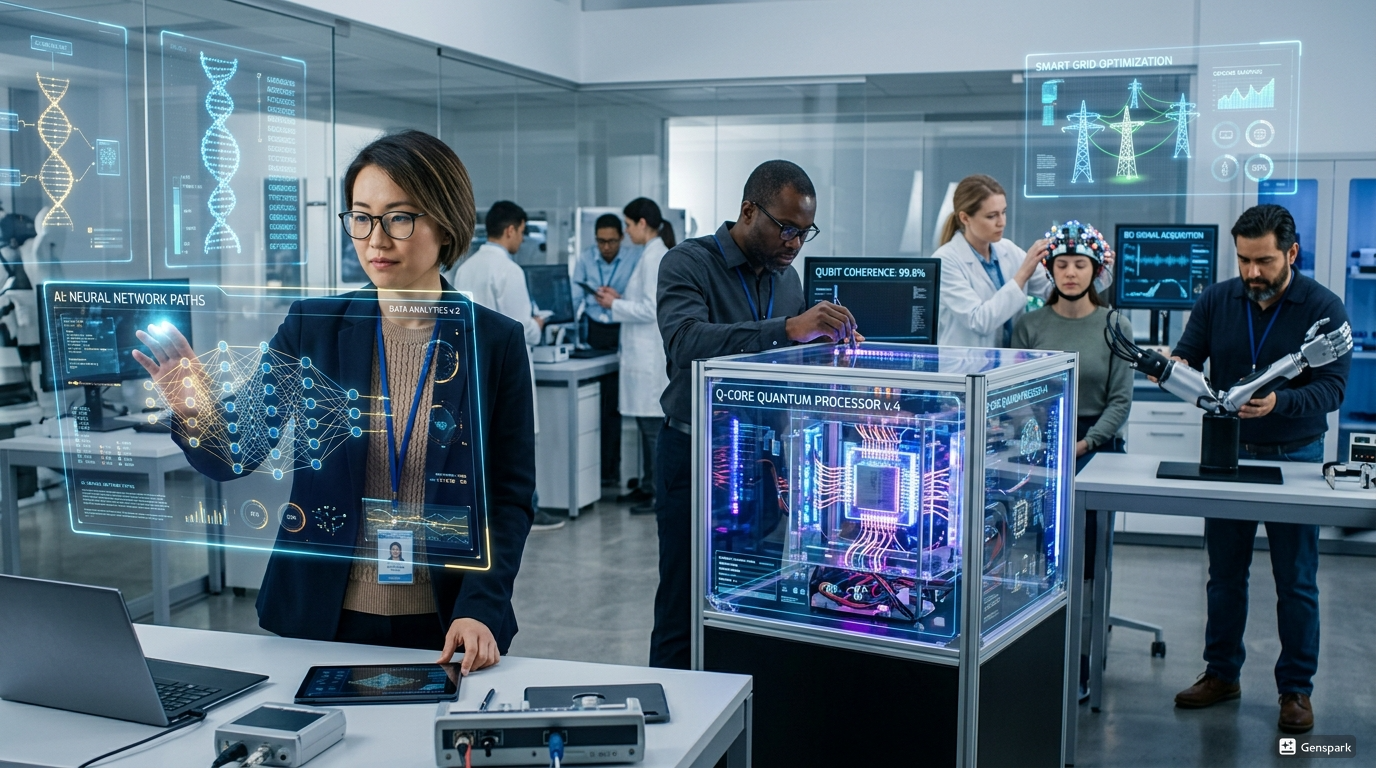
Every year for the past decade, the same list of technologies has appeared under the heading “breakthroughs to watch” — AI, quantum computing, blockchain, AR/VR, autonomous vehicles. The problem with most of these lists is not that the technologies are wrong. It is that they present speculative futures as imminent realities, give no honest assessment of where each technology actually stands, and provide no useful framework for understanding which breakthroughs are genuinely close and which remain years away.
This guide takes a different approach. For each major emerging technology, it answers three specific questions: What has concretely happened in 2025–26 that represents real progress? What is still genuinely far from practical deployment despite the hype? And where does India specifically stand in relation to this technology — as a user, a builder, or a beneficiary?
Artificial Intelligence: From Hype to Infrastructure
AI is no longer “emerging” in the way the term typically implies. It has moved from research curiosity to deployed infrastructure that underlies products used by hundreds of millions of people daily. The more useful framing in 2026 is not whether AI will be transformative — it already is — but which specific AI capabilities are genuinely mature versus which are still overpromised.
What Has Matured
Large language models — the category that includes GPT-4, Claude, and Gemini — have crossed the threshold from impressive demonstrations to reliable workhorses for specific tasks. Code generation, document summarisation, translation, customer service routing, and content drafting are areas where AI now performs at or above human baseline speed for many use cases, and enterprises across India are deploying these capabilities in production at scale.
In healthcare, Google’s AMIE (Articulate Medical Intelligence Explorer) demonstrated diagnostic reasoning comparable to primary care physicians in structured studies in 2024. Meanwhile, Wadhwani AI — a Mumbai-based nonprofit AI lab — has deployed tuberculosis detection tools across India that analyse chest X-rays and flag TB cases with over 90% sensitivity, helping address one of India’s largest public health challenges in settings where radiologists are scarce.
In agriculture, Microsoft’s AI for Agriculture partnership with ICRISAT and the Indian government has deployed crop disease detection tools that farmers access through WhatsApp — photograph a plant, receive a disease diagnosis and treatment recommendation within seconds. This is not a pilot. It is an operational tool used by millions of Indian farmers.
What Is Still Overhyped
“Artificial General Intelligence” — AI that can reason across any domain at human level — remains fundamentally speculative. Despite aggressive timelines claimed by some AI lab executives, no AGI system exists in any form, and the path from current language models to genuine general reasoning involves unsolved scientific problems, not just scaling compute. Take any specific AGI timeline claim with significant scepticism.
AI “agents” that can autonomously handle complex, multi-step real-world tasks — managing your email inbox, booking travel, handling business negotiations — are being heavily marketed but remain unreliable in practice. Current AI agents handle narrow, well-defined tasks adequately but break down on tasks requiring genuine world knowledge, contextual judgment, and error recovery. The gap between demo and reality here is large.
India’s AI Position
India has emerged as one of the three most significant AI ecosystems globally, alongside the US and China. IndiaAI Mission, launched with ₹10,372 crore in funding in 2024, is building sovereign AI compute infrastructure — a network of GPU clusters accessible to Indian startups and researchers — that addresses the compute access gap that has historically disadvantaged Indian AI developers relative to Silicon Valley peers. BharatGPT, Sarvam AI, and Krutrim are building India-specific large language models trained on Indian languages and cultural contexts, addressing the gap where existing global models perform poorly in Hindi, Tamil, Telugu, Bengali, and other Indian languages.
Quantum Computing: Real Progress, But Not Yet the Revolution
Quantum computing receives more hype per actual practical impact than almost any other technology. The breakthroughs are real; the timelines for practical applications are not.
What Has Concretely Happened
IBM’s quantum hardware roadmap has progressed as planned. Their 1,121-qubit Condor processor was demonstrated in 2023, and the architecture has continued advancing. Google’s quantum supremacy claims — where their quantum processor solved a specific mathematical problem faster than any classical supercomputer could — have been replicated and refined. Microsoft demonstrated its topological qubit approach in 2025, which addresses the error correction problem that has been the primary barrier to practical quantum computation.
These are genuine scientific milestones. The qubit count is growing, error rates are declining, and the engineering problems that prevent quantum computers from performing useful work are being systematically addressed.
The Honest Timeline
Practical quantum advantage — where a quantum computer solves a real-world problem better than the best available classical solution — does not exist yet for any commercially relevant application. The quantum computers available in 2026, including through cloud access platforms like IBM Quantum and AWS Braket, are powerful research tools that are helping researchers understand quantum algorithms and hardware. They are not yet replacing classical computers for any practical task.
Conservative expert estimates place fault-tolerant quantum computers capable of cracking current encryption standards or performing meaningful pharmaceutical simulations at approximately 10–15 years away. Optimistic estimates say five to seven years. Either way, 2026 is a year for quantum education and preparation, not quantum deployment for most organisations.
Why India Should Pay Attention Now
India’s National Quantum Mission, approved in 2023 with ₹6,003 crore in funding over eight years, is building domestic quantum capabilities in hardware, software, and applications. IISc Bengaluru, IIT Mumbai, and TIFR are among the institutions building India’s quantum research base. The practical payoff is years away, but the talent and infrastructure being built now will determine whether India is a participant or a bystander in the quantum economy of the 2030s.
For individuals and businesses, the immediate relevance is cryptographic: current public key encryption (RSA, ECC) that protects internet banking, UPI, and most secure communications will be vulnerable to sufficiently powerful quantum computers. The cybersecurity community is already preparing post-quantum cryptographic standards, and organisations handling sensitive data for long time horizons should begin migrating toward quantum-resistant encryption now, well before quantum computers capable of breaking current encryption actually exist.
Generative AI for Creative and Professional Work: Already Here
While AGI remains speculative, generative AI for specific creative and professional domains has moved from experimental to mainstream faster than most technology transitions in history.
Image generation with Midjourney, DALL-E 3, and Stable Diffusion has reached a quality level where AI-generated images are routinely indistinguishable from photographs in controlled comparisons. Video generation — Sora (OpenAI), Runway Gen-3, and Kling — has made multi-second high-quality video clips accessible to anyone with a browser, though full-length coherent video production remains challenging.
In software development, GitHub Copilot and similar tools have measurably increased developer productivity — a study published in 2023 found developers using Copilot completed tasks 55% faster on average. This does not mean programmers are becoming obsolete; it means the productivity of existing programmers is rising, and the barrier to building functional software is falling for people with domain knowledge but limited coding experience.
For Indian professionals, the most immediate impact is in knowledge work: lawyers using AI for contract review and research, doctors using AI for medical literature synthesis, accountants using AI for data extraction and preliminary analysis, and content creators using AI for research, drafting, and translation. The competitive advantage in 2026 belongs to professionals who have developed fluency with AI tools in their specific domain — not to those who either dismiss AI entirely or over-rely on it without critical judgment.
5G in India: What the Rollout Has Actually Delivered
India’s 5G rollout — executed at a speed that surprised many industry observers — has achieved genuine coverage milestones. Jio and Airtel both launched 5G services in October 2022 and have expanded to cover all 28 states and most major cities and towns by 2025. India now has the second-largest 5G subscriber base in Asia-Pacific, and data consumption on 5G networks is running at approximately three to four times the per-user consumption on 4G.
The honest assessment of what 5G has actually changed in India in 2026: for consumers, the primary experience is faster mobile data speeds and more reliable connectivity in congested areas like stadiums, railway stations, and commercial districts. The transformative enterprise applications — private 5G networks for factory automation, real-time remote surgery, massive IoT deployments for smart cities — are real use cases in pilot and early deployment stages, but are not yet widespread.
The most significant 5G application beginning to show practical results in India is fixed wireless access — using 5G networks to deliver home broadband in areas where fibre installation is impractical. Both Jio AirFiber and Airtel Xstream AirFiber are expanding this service aggressively in tier-2 and tier-3 cities, addressing the last-mile broadband access problem that has been a barrier to digital participation in smaller cities and towns.
Biotech and Genomics: India’s Emerging Edge
Biotechnology is the emerging technology category where India has the most differentiated, genuine competitive advantage — and where practical applications for Indian consumers are arriving fastest.
COVID-19 as catalyst. India’s development and manufacturing of Covaxin — an indigenous COVID-19 vaccine developed by Bharat Biotech — demonstrated that India had both the scientific capability and the manufacturing scale to develop novel vaccines domestically. This has catalysed significant investment in Indian biotech infrastructure.
Genomics and personalised medicine. The cost of whole human genome sequencing has fallen from approximately $100 million in 2001 to under $200 today, and is projected to fall below $100 by 2027. This cost collapse is making genomic data clinically actionable for the first time. Indian companies including MedGenome, Strand Life Sciences, and Xcelris Labs are building genomic testing infrastructure specifically calibrated for Indian genetic diversity — which differs significantly from the Western populations that dominate global genomic databases.
Practically, this means diagnostic tests for hereditary cancer risk, pharmacogenomics (which medication doses work for your specific genetic metabolism), and rare genetic disease identification are becoming accessible at price points Indian families can afford. MedGenome’s cancer hereditary risk panels now cost ₹8,000–15,000, compared to ₹50,000+ just five years ago.
TB, malaria, and neglected diseases. AI combined with new rapid diagnostic technologies is producing tools specifically designed for the disease burden of Indian and developing-world populations — areas where Western pharmaceutical R&D historically underinvests because profit margins are lower. The Bill & Melinda Gates Foundation and Wellcome Trust have backed several India-based research programs in these areas, and the first products are beginning to reach clinical use.
Electric Vehicles: The Transition Happening Right Now
EV technology is no longer emerging in India — it is the fastest-growing segment of the automotive market by volume. India sold approximately 1.7 million electric two-wheelers in FY2024-25, and the electric two-wheeler penetration rate is now approaching 10% of total two-wheeler sales — a threshold that marks the beginning of mainstream adoption curves in most technology transitions.
Tata Motors has established genuine dominance in the electric passenger car segment, with the Tiago EV, Nexon EV, and Punch EV together accounting for the majority of India’s electric passenger car sales. MG (with the Windsor EV), Mahindra (with the BE6e and XEV 9e), and BYD are mounting genuine competition in the ₹15–40 lakh segment. The ecosystem question — battery technology, charging infrastructure, resale value certainty — that has been the primary barrier to mass EV adoption is being addressed sequentially.
Charging infrastructure remains the most significant practical limitation. India’s public charging network has grown significantly but remains concentrated in major highways and metro cities. Range anxiety on inter-city journeys outside established EV corridors is a legitimate concern that affects buying decisions. Tata Power, Ather Grid, ChargeZone, and Statiq are all expanding networks aggressively, and the FAME III policy framework is providing subsidy support for charging infrastructure in tier-2 and tier-3 cities. The infrastructure gap is closing but has not yet closed.
The technology story behind EV acceleration: lithium iron phosphate (LFP) battery chemistry, which offers better thermal stability and longer cycle life than the NCM chemistry used in earlier EVs, has become the dominant chemistry in Indian EVs at accessible price points. Tata Group’s investment in AGRATAS (their battery manufacturing entity) and the India government’s PLI scheme for Advanced Chemistry Cell manufacturing are building domestic battery production capacity that will reduce India’s current near-total dependence on Chinese battery imports.
What India Should Watch in the Next 24 Months
Several technology transitions are at inflection points where practical Indian applications will arrive within the next two years specifically:
Agentic AI for Indian languages. Sarvam AI and others are building AI agents capable of conducting extended voice conversations in Hindi, Tamil, and other Indian languages — enabling AI-powered interfaces for the hundreds of millions of Indians who are more comfortable speaking than typing, and who have been largely excluded from AI productivity gains so far.
Satellite broadband. OneWeb (in which the Bharti group is a major investor) and Elon Musk’s Starlink (which received Indian operating approval in 2025) are expanding satellite broadband access to genuinely remote areas where terrestrial fibre and mobile networks are uneconomical. For schools, healthcare facilities, and small businesses in India’s most underserved rural areas, this may be the connectivity infrastructure that has the most tangible near-term impact.
AI-powered vernacular health tools. The combination of low-cost smartphones, 5G connectivity, and increasingly capable Indian-language AI is enabling a new category of health tool designed for primary healthcare access in settings where doctors are scarce. Partnerships between AI companies and ASHAs (Accredited Social Health Activists) and government health programmes are putting diagnostic support tools in the hands of frontline health workers across rural India.
A Framework for Evaluating Any Emerging Technology Claim
The most useful skill for navigating technology coverage in 2026 is not knowing what every technology does — it is being able to distinguish genuine progress from hype. Three questions that cut through most technology claims:
Is there a deployed product, or just a demonstration? Demonstrations can be selectively staged to show best-case performance. Deployed products used by real users at scale reveal actual reliability, edge cases, and limitations. Prioritise evidence of deployment over evidence of demonstration.
What is the specific problem being solved, and what does it replace? Vague claims about “transforming industries” or “revolutionising communication” are not falsifiable and therefore not useful. A technology claim worth taking seriously names the specific problem, the specific population whose problem is being solved, and the specific thing it replaces or displaces.
Who benefits commercially from you believing this is more advanced than it is? AI companies raising investment rounds, chip manufacturers selling GPUs, and quantum computing startups seeking government grants all have financial incentives to present their technology as more mature than honest assessment suggests. This does not mean they are lying — but it does mean independent validation is more useful than vendor claims.
This article is for informational and educational purposes only. Technology development timelines and market data mentioned are based on publicly available information as of May 2026 and are subject to change. Investment decisions related to emerging technology companies should be made in consultation with qualified financial advisers.
Mahesh is a technology writer covering AI, emerging tech, and digital infrastructure in India and globally.
